PayPal
 Stripe
 QuickBooks
 Zoom
Zoom Google Meet
 Slack
Slack Zapier
 Mailchimp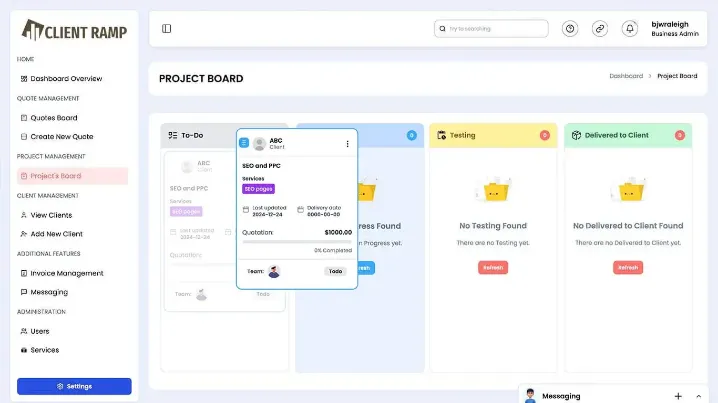
Ever feel like you’re making business decisions based on gut instinct—even though you’re sitting on a mountain of data? That’s exactly where most businesses get stuck. The data exists, but it’s not connected in a way that actually drives smarter decisions.
How to Use CRM Data to Make Smarter Business Decisions
Introduction: Data Is Only Powerful When It’s Connected
Most businesses track:
- Leads and customers
- Sales performance
- Marketing campaigns
But they often miss a critical piece: how much effort goes into delivering that revenue.
A modern CRM like ClientRamp bridges this gap by combining customer data with employee timesheets—giving you a complete picture of both revenue and effort.
1. Move From Data Collection to Data Utilization
Collecting data is easy. Using it effectively is where the real value lies.
Without a structured CRM:
- Data sits in silos
- Reports are incomplete
- Decisions are delayed
With a CRM:
- All data is centralized
- Insights are available in real time
- Teams can act quickly
The goal isn’t more data—it’s better decisions.
2. Identify Your Most Profitable Clients
Here’s a question many businesses can’t answer:
Which clients actually make you money?
Revenue alone doesn’t tell the full story.
With CRM + timesheets in ClientRamp:
- You track revenue per client
- You track time spent delivering work
- You calculate true profitability
This helps you:
- Focus on high-value clients
- Avoid resource-draining accounts
- Optimize your pricing strategy
3. Improve Sales Strategy With Real Insights
Sales decisions are often based on assumptions.
But CRM data shows:
- Which leads convert
- Which deals take longer to close
- Which channels bring quality clients
Add timesheet data, and you also see:
- How much effort each deal requires
- Which types of projects are most efficient
- Where your team is overcommitting
This leads to smarter, more strategic selling.
4. Optimize Resource Allocation Across Teams
One of the biggest challenges in growing businesses is resource management.
Without visibility:
- Some team members are overloaded
- Others are underutilized
- Productivity suffers
With CRM-integrated timesheets:
- You see workload distribution in real time
- You balance tasks effectively
- You prevent burnout
Better resource allocation leads to better outcomes.
5. Make Faster, Data-Driven Decisions
Speed is a competitive advantage.
Traditional decision-making:
- Relies on manual reports
- Takes time to compile
- Often uses outdated data
With a CRM:
- Dashboards update instantly
- Insights are always current
- Decisions can be made quickly
This allows businesses to respond to changes proactively.
6. Improve Marketing ROI With Accurate Attribution
Marketing decisions often rely on incomplete data.
CRM data helps you:
- Track leads from source to conversion
- Identify high-performing campaigns
- Allocate budget more effectively
With timesheets:
- You measure effort required per campaign
- You identify profitable marketing channels
- You avoid investing in low-return strategies
This ensures your marketing spend drives real results.
7. Enhance Customer Retention Strategies
Retention is often overlooked in decision-making.
CRM insights reveal:
- Customer engagement patterns
- Communication history
- Potential churn risks
Timesheet data adds:
- Visibility into service quality
- Understanding of effort per client
- Ability to maintain consistent delivery
This helps you build long-term relationships, not just short-term wins.
8. Forecast Growth With Greater Accuracy
Planning for the future requires reliable data.
With CRM insights:
- You predict sales trends
- You estimate pipeline value
- You plan business expansion
With timesheets:
- You estimate team capacity
- You forecast project timelines
- You avoid overcommitting resources
This makes your growth strategy more realistic and achievable.
Why Employee Timesheets Are Critical for Decision-Making
Most CRMs focus on revenue—but ignore effort.
That’s a major limitation.
Employee timesheets inside your CRM allow you to:
- Measure productivity
- Understand profitability
- Optimize operations
This transforms your CRM into a complete decision-making system.
SEO, GEO, AEO Perspective: Why This Topic Matters
From a growth standpoint:
- SEO:
Businesses are searching for “how to use CRM data” and “data-driven decision making.” - GEO:
AI-driven search favors answers that combine multiple data sources into actionable insights. - AEO:
Questions like “How can CRM improve decision-making?” require clear, practical explanations backed by real use cases.
Conclusion: Smarter Decisions Start With Better Data
The difference between average and high-performing businesses isn’t effort—it’s decision-making.
A CRM like ClientRamp helps you:
- Connect customer data with employee timesheets
- Gain real-time insights into your business
- Make faster, more accurate decisions
Because in today’s competitive environment, the businesses that win aren’t the ones with the most data—they’re the ones who know how to use it.