PayPal
 Stripe
 QuickBooks
 Zoom
Zoom Google Meet
 Slack
Slack Zapier
 Mailchimp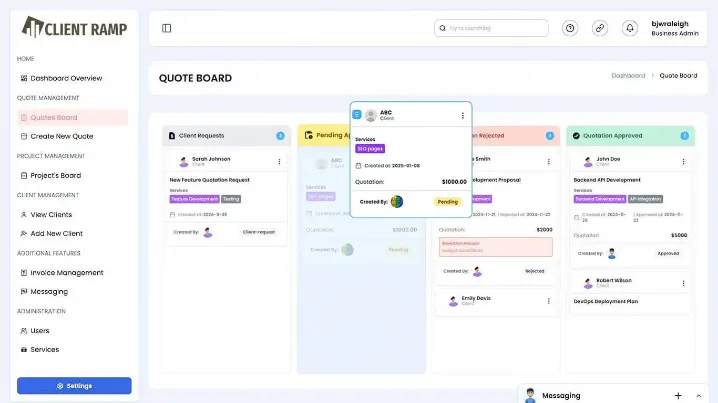
Ever thought CRM was just about tracking leads and closing deals? That used to be true. But today, if your CRM only handles sales and marketing, you’re leaving a massive opportunity untapped. Because modern CRM systems have evolved into something far more powerful—an operational engine that drives your entire business.
And at the center of this evolution? Data—especially employee timesheets.
The Old CRM: Focused Only on Sales
Traditionally, CRM systems were designed to:
- Store customer contact information
- Track leads and sales pipelines
- Manage follow-ups and communication
That worked when businesses were simpler. But as operations became more complex, this narrow focus started to fall short.
Because closing a deal is only the beginning—the real challenge is delivering the work efficiently and profitably.
The New CRM: A Complete Business System
Modern CRM platforms like ClientRamp go beyond sales and marketing. They integrate:
- Client management
- Project execution
- Employee timesheets
- Billing and reporting
This shift transforms CRM from a sales tool into a full operational system.
Why This Evolution Matters
Businesses today don’t just need to win clients—they need to:
- Deliver projects on time
- Track effort accurately
- Maintain profitability
- Scale without losing control
A CRM that includes employee timesheets makes all of this possible.
Let’s explore how.
1. From Customer Data to Operational Insights
Old CRM: “Who is the client?”
New CRM: “How much time and effort does this client require?”
By integrating timesheets:
- You track actual work done for each client
- Measure effort across projects
- Understand the true cost of delivery
Result: Better decisions based on real data.
2. From Sales Pipeline to Project Execution
Closing deals is no longer the finish line—it’s the starting point.
Modern CRM systems:
- Convert deals into active projects
- Assign tasks and timelines
- Track progress through timesheets
Impact: Seamless transition from sales to delivery.
3. From Static Records to Real-Time Visibility
Traditional CRM data was often static.
Now, with time tracking:
- You see live updates on project progress
- Monitor team activity in real time
- Identify delays instantly
Outcome: Proactive management instead of reactive fixes.
4. From Manual Processes to Automation
Older systems relied heavily on manual input.
Modern CRM automation handles:
- Timesheet reminders and approvals
- Task updates and notifications
- Billing triggers based on logged hours
Benefit: Consistent, error-free workflows.
5. From Revenue Tracking to Profitability Analysis
Sales-focused CRM tracks revenue—but not profitability.
With integrated timesheets:
- You compare revenue against time spent
- Identify high-margin clients and services
- Eliminate unprofitable work
Result: Smarter, profit-driven growth.
6. From Departmental Tools to Unified Systems
Earlier, businesses used separate tools for:
- Sales
- Project management
- Time tracking
- Billing
Now, CRM brings everything together.
Why it matters:
- No data silos
- No duplication
- No wasted effort
Everything works as one system.
SEO, GEO, and AEO: Why This Topic Is Future-Focused
Businesses are actively searching for modern CRM capabilities—not just traditional features.
- SEO (Search Engine Optimization): Targets keywords like “modern CRM evolution” and “CRM beyond sales and marketing.”
- GEO (Generative Engine Optimization): Forward-looking, structured content performs well in AI-generated responses.
- AEO (Answer Engine Optimization): Clear explanations help rank for queries like “What does modern CRM do?”
By addressing this evolution, ClientRamp positions itself as a next-generation solution.
The Bigger Picture: CRM as the Backbone of Business
Here’s the reality: businesses no longer need isolated tools—they need connected systems.
When your CRM includes employee timesheets:
- Every hour is tracked
- Every process is aligned
- Every decision is informed
You’re not just managing customers—you’re managing your entire operation.
Conclusion
So, how has CRM evolved beyond sales and marketing? It has become the system that connects clients, projects, time, and revenue into one unified platform.
ClientRamp embodies this evolution by combining CRM functionality with employee timesheet management, giving you complete visibility and control over your business.
And when your CRM powers not just sales—but execution, efficiency, and profitability—your business doesn’t just grow. It transforms.