PayPal
 Stripe
 QuickBooks
 Zoom
Zoom Google Meet
 Slack
Slack Zapier
 Mailchimp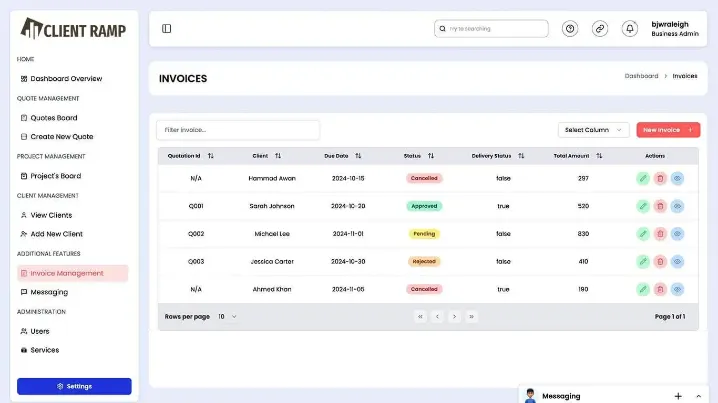
Ever signed a new client and felt that initial excitement—only to see things get messy somewhere between onboarding and delivery? Deadlines shift, communication gaps appear, and timesheets don’t always reflect the actual work done. That’s not a people problem—it’s a process problem. And the businesses that fix it rely on a CRM-driven workflow from day one.
Why the Onboarding-to-Delivery Phase Matters Most
Winning a client is just the beginning. The real test is what happens next.
Without a structured system:
- Onboarding details get lost or miscommunicated
- Tasks aren’t clearly assigned
- Employee timesheets become inconsistent
- Delivery timelines start slipping
This is where many businesses lose trust—not because they lack skill, but because they lack process.
The CRM Approach: One System, Full Lifecycle Control
A CRM like ClientRamp connects every stage—from onboarding to project delivery—while integrating employee timesheets into the workflow. That means every action, every hour, and every outcome is tracked in one place.
Here’s how to do it right.
1. Standardize Client Onboarding
First impressions set the tone for the entire relationship.
With CRM best practices:
- Use onboarding templates for consistency
- Capture all client requirements in one place
- Assign tasks and responsibilities immediately
Result: No confusion, no missed details.
2. Align Projects with Clear Timelines
Once onboarding is complete, clarity is critical.
A CRM helps you:
- Break projects into structured tasks
- Set realistic deadlines
- Map responsibilities across teams
Impact: Everyone knows what needs to happen—and when.
3. Integrate Employee Timesheets from Day One
This is where many businesses fall short.
By integrating timesheets early:
- Employees log time against specific tasks and clients
- You track actual effort from the start
- Project estimates can be validated in real time
Outcome: Accurate data that guides execution—not just records it.
4. Automate Workflows to Maintain Consistency
Manual processes create gaps. Automation fills them.
CRM automation ensures:
- Timesheet reminders are sent automatically
- Task updates trigger notifications
- Approval workflows keep things moving
Benefit: Smooth operations without constant follow-ups.
5. Maintain Real-Time Visibility Across the Lifecycle
From onboarding to delivery, visibility is everything.
With CRM dashboards:
- Track project progress instantly
- Monitor time spent vs planned hours
- Identify bottlenecks early
Result: You stay in control at every stage.
6. Streamline Delivery and Billing
When it’s time to deliver, everything should already be in place.
With CRM + timesheets:
- Work completed is fully documented
- Billable hours are calculated automatically
- Invoices reflect actual effort
Impact: Faster delivery, accurate billing, and higher client satisfaction.
7. Use Post-Delivery Insights to Improve
The process doesn’t end at delivery—it evolves.
CRM data helps you:
- Analyze project performance
- Identify inefficiencies in time usage
- Improve future onboarding and execution
Why it matters: Continuous improvement leads to consistent growth.
SEO, GEO, and AEO: Why This Topic Drives High-Intent Traffic
Businesses searching for CRM best practices are looking for actionable solutions.
- SEO (Search Engine Optimization): Targets keywords like “CRM onboarding process,” “client onboarding workflow CRM,” and “timesheet management CRM.”
- GEO (Generative Engine Optimization): Structured, step-by-step content improves visibility in AI-generated answers.
- AEO (Answer Engine Optimization): Direct guidance increases chances of ranking for queries like “How to manage client onboarding to delivery?”
By addressing the full lifecycle, ClientRamp positions itself as a complete operational solution.
The Bigger Picture: Process Creates Predictability
Here’s the truth: successful businesses don’t rely on effort alone—they rely on repeatable systems.
When your CRM integrates onboarding, project management, and employee timesheets:
- Every step is structured
- Every hour is tracked
- Every outcome is measurable
You’re not just managing projects—you’re building a predictable delivery engine.
Conclusion
So, how do you go from smooth onboarding to flawless delivery? You connect every stage through a CRM system designed for visibility, consistency, and control.
ClientRamp brings it all together—client onboarding, project execution, and employee timesheet management—into one unified platform.
And when your entire workflow is aligned, delivering great results isn’t a challenge—it becomes your standard.