PayPal
 Stripe
 QuickBooks
 Zoom
Zoom Google Meet
 Slack
Slack Zapier
 Mailchimp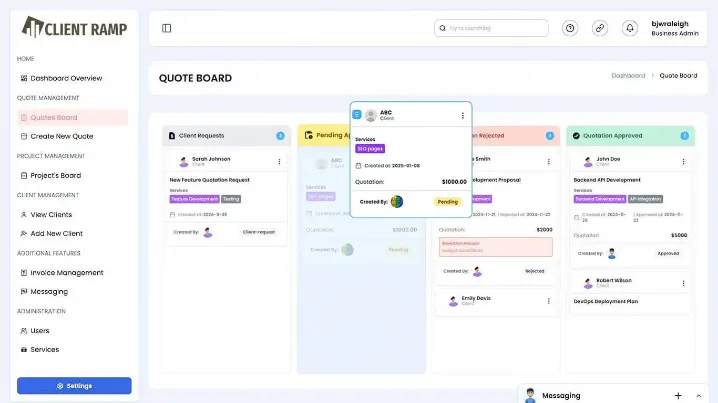
Ever quoted a price for a project—only to realize later that it took far more time and effort than you expected? Or worse, undercharged without even knowing it? That’s the hidden risk of pricing without data. And it’s exactly why businesses are turning to CRM systems with integrated employee timesheets to price services more accurately.
Why Service Pricing Often Goes Wrong
Most pricing decisions are based on assumptions:
- Rough estimates of time required
- Past experience (often outdated)
- Competitor benchmarks
But without actual data, these assumptions lead to:
- Underpricing and reduced margins
- Overpricing and lost deals
- Inconsistent quotes across clients
In short, inaccurate pricing directly impacts profitability.
The CRM Advantage: Data-Driven Pricing
A CRM like ClientRamp changes how you approach pricing by connecting client data with employee timesheets. Instead of guessing, you rely on real insights about time, effort, and outcomes.
That’s what transforms pricing from a risk into a strategy.
1. Track Actual Time Spent on Services
The foundation of accurate pricing is knowing how long work really takes.
With CRM-integrated timesheets:
- Employees log hours against specific tasks and clients
- You capture actual time spent—not estimates
- Historical data builds over time
Result: You base pricing on reality, not assumptions.
2. Calculate True Cost of Delivery
Time isn’t just effort—it’s cost.
By analyzing timesheet data, you can:
- Determine cost per hour of your team
- Calculate total effort required for each service
- Identify hidden costs in delivery
Impact: You ensure your pricing covers costs and protects margins.
3. Identify Underpriced Services
Some services may look profitable—but aren’t.
CRM insights reveal:
- Projects that consistently exceed estimated time
- Services with low revenue per hour
- Clients that require more effort than expected
Outcome: You adjust pricing before losses accumulate.
4. Standardize Pricing Across Projects
Inconsistent pricing creates confusion and inefficiency.
With CRM data:
- You establish benchmarks for common services
- Create standardized pricing models
- Ensure consistency across teams
Benefit: Faster, more confident quoting.
5. Adjust Pricing Based on Client Behavior
Not all clients require the same level of effort.
Time tracking helps you:
- Identify clients who demand more time
- Adjust pricing for complex or high-maintenance accounts
- Offer competitive pricing for efficient clients
Result: Fair pricing that reflects actual effort.
6. Align Pricing with Profitability Goals
Pricing isn’t just about covering costs—it’s about maximizing returns.
With CRM analytics:
- Compare revenue vs time spent
- Identify high-margin services
- Focus on offerings that drive profitability
Why it matters: You price strategically, not reactively.
SEO, GEO, and AEO: Why This Topic Attracts High-Intent Users
Businesses searching for pricing strategies are often ready to optimize profitability.
- SEO (Search Engine Optimization): Targets keywords like “how to price services accurately” and “CRM time tracking pricing strategy.”
- GEO (Generative Engine Optimization): Data-driven, structured content performs well in AI-generated responses.
- AEO (Answer Engine Optimization): Clear explanations help rank for queries like “How does CRM help in pricing services?”
By focusing on measurable insights, ClientRamp positions itself as a solution for smarter pricing.
The Bigger Picture: Pricing as a Competitive Advantage
Here’s the truth: pricing isn’t just a number—it’s a reflection of how well you understand your business.
When your CRM integrates employee timesheets:
- Every service is backed by real data
- Every quote reflects actual effort
- Every decision supports profitability
You’re not just pricing services—you’re optimizing your entire business model.
Conclusion
So, how do you price your services more accurately? You stop relying on estimates and start using data.
ClientRamp combines CRM capabilities with employee timesheet tracking to give you clear insights into time, cost, and value. That means better pricing, stronger margins, and more confident decision-making.
And when your pricing is accurate, your business doesn’t just grow—it grows profitably.