PayPal
 Stripe
 QuickBooks
 Zoom
Zoom Google Meet
 Slack
Slack Zapier
 Mailchimp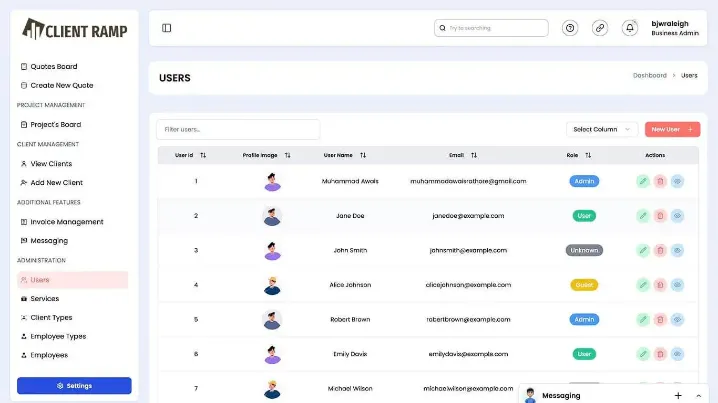
Ever wondered why some businesses run like a well-oiled machine while others constantly struggle with missed follow-ups, scattered data, and operational chaos? It’s not just about having a great team—it’s about having the right system to connect everything.
In today’s fast-moving environment, a CRM isn’t just a sales tool—it’s the central nervous system of modern business operations. And when combined with employee timesheets, like in ClientRamp, it becomes a powerful engine for efficiency, visibility, and growth.
Why CRM Is No Longer Optional
Modern businesses deal with:
- Multiple clients and touchpoints
- Complex workflows and projects
- Distributed teams and remote work
Without a centralized system:
- Information gets fragmented
- Communication breaks down
- Productivity declines
A CRM solves this by bringing structure and clarity to your operations.
What Does a CRM Actually Do Today?
Traditionally, CRMs were used to manage contacts and sales pipelines. But today, their role has expanded significantly.
A modern CRM helps you:
- Manage client relationships end-to-end
- Track projects and tasks
- Automate workflows
- Analyze performance data
When integrated with employee timesheets, it also enables:
- Time tracking across teams
- Productivity measurement
- Profitability analysis
This transforms CRM from a tracking tool into a decision-making platform.
1. Centralizing Business Operations
Imagine managing clients, projects, and tasks across multiple tools—it’s inefficient and error-prone.
A CRM like ClientRamp centralizes:
- Client data and communication
- Project details and updates
- Task assignments and progress
This ensures:
- Everyone works with the same information
- Nothing gets lost or duplicated
- Operations stay organized as you grow
2. Improving Team Productivity
Here’s a critical question:
Do you know how your team spends their time every day?
Without visibility:
- Productivity gaps remain hidden
- Workloads become unbalanced
- Efficiency suffers
Employee timesheets solve this by:
- Tracking time per task and project
- Highlighting inefficiencies
- Enabling better resource allocation
When you understand time, you improve performance.
3. Enabling Data-Driven Decisions
Modern businesses can’t rely on intuition alone.
A CRM provides insights such as:
- Client engagement levels
- Sales pipeline performance
- Project progress
Timesheet data adds:
- Effort vs outcome analysis
- Team productivity metrics
- Cost of delivering services
With this combined data, decisions become:
- Faster
- More accurate
- More impactful
4. Automating Repetitive Processes
Manual processes slow down operations and increase errors.
CRM automation helps you:
- Assign tasks automatically
- Send follow-ups and reminders
- Trigger workflows based on actions
When paired with timesheets:
- Time tracking reminders are automated
- Reporting becomes effortless
Automation ensures consistency and frees up time for strategic work.
5. Enhancing Client Experience
Clients expect:
- Quick responses
- Transparency
- Consistent service
A CRM enables:
- Centralized communication
- Real-time updates
- Personalized interactions
Employee timesheets add:
- Clear visibility into work done
- Accurate billing
- Data-backed reporting
This builds trust and strengthens relationships.
6. Managing Growth Without Chaos
As your business grows, complexity increases.
Without systems:
- Processes break down
- Teams become overwhelmed
- Profitability declines
A CRM ensures:
- Scalable workflows
- Organized operations
- Controlled growth
Timesheets ensure:
- Every hour is tracked
- Every effort is measured
- Every inefficiency is addressed
7. Connecting Sales, Operations, and Finance
One of the biggest advantages of a modern CRM is integration.
It connects:
- Sales (leads, deals, conversions)
- Operations (tasks, projects, delivery)
- Finance (billing, profitability)
Employee timesheets act as the bridge:
- Linking effort to revenue
- Connecting work to outcomes
- Providing a complete business view
Why ClientRamp Stands Out
ClientRamp is designed to support modern business operations by combining:
- CRM functionality for managing clients and workflows
- Employee timesheets for tracking time and productivity
- Automation tools for efficiency
- Real-time analytics for smarter decisions
This unified approach eliminates the need for multiple disconnected tools.
The Bigger Insight: Operations Thrive on Visibility
Think about digital marketing—would you run campaigns without tracking performance metrics? That would lead to wasted spend and poor results.
The same principle applies to your operations.
Without CRM and time tracking:
- You lose visibility
- You make reactive decisions
- You limit growth potential
With the right system:
- Every process is tracked
- Every hour is accounted for
- Every decision is optimized
Final Thoughts
The role of CRM in modern business operations goes far beyond managing contacts—it’s about creating a structured, data-driven, and scalable system.
By leveraging a CRM with integrated employee timesheets like ClientRamp:
- You streamline operations
- You improve productivity
- You enhance client relationships
- You drive sustainable growth
And most importantly, you turn your business into a well-organized, high-performing operation.
So the real question is: is your CRM just supporting your business—or actively driving its success?