PayPal
 Stripe
 QuickBooks
 Zoom
Zoom Google Meet
 Slack
Slack Zapier
 Mailchimp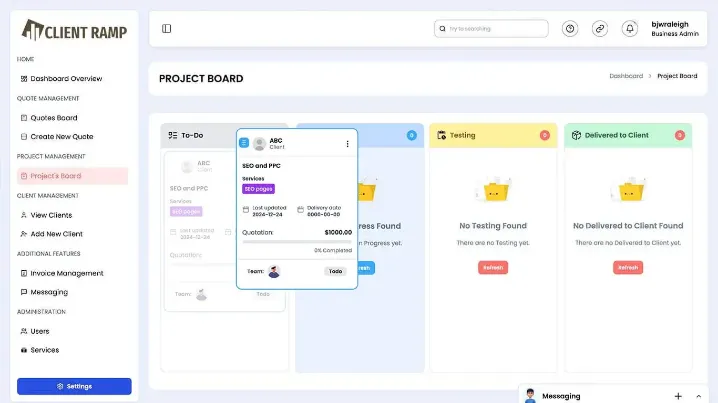
Ever wonder why some companies always seem one step ahead—spotting opportunities faster, fixing problems earlier, and growing more efficiently? It’s not luck. It’s data. More specifically, how they use their CRM data—combined with employee timesheets—to make smarter decisions every single day.
Because in today’s competitive landscape, intuition isn’t enough. Data-driven execution is what separates leaders from everyone else.
What It Means to Be a Data-Driven Company
Being data-driven isn’t about collecting more information—it’s about using the right data to guide decisions.
For fast-moving businesses, that means:
- Tracking how time is actually spent
- Understanding the true cost of delivering services
- Measuring performance in real time
- Acting on insights, not assumptions
And this is exactly where a CRM like ClientRamp becomes essential.
Why CRM Is the Core of Data-Driven Operations
A CRM centralizes your most valuable data—clients, projects, and interactions. But when you integrate employee timesheets into that system, you unlock something far more powerful: visibility into effort, efficiency, and profitability.
That’s the foundation of staying ahead.
1. Real-Time Time Tracking Drives Better Decisions
Data-driven companies don’t wait for reports—they act in real time.
With CRM-integrated timesheets:
- Employees log hours against tasks and clients
- Managers see live progress across projects
- Delays and inefficiencies are identified instantly
Result: Faster decisions, fewer surprises.
2. Accurate Performance Measurement
Without data, performance is subjective.
CRM insights help you:
- Measure employee productivity
- Evaluate project efficiency
- Track billable vs non-billable time
Impact: Clear, objective performance metrics.
3. Smarter Resource Allocation
Where should your team focus their time?
Time tracking data reveals:
- High-impact tasks vs low-value work
- Overloaded and underutilized team members
- Opportunities to optimize workflows
Outcome: Maximum output from existing resources.
4. Profitability Insights That Drive Growth
Revenue alone doesn’t tell the full story.
By combining CRM and timesheet data:
- You calculate revenue per hour
- Identify high-margin clients and services
- Eliminate unprofitable work
Benefit: Growth that actually increases profit.
5. Predictive Planning and Forecasting
Data-driven companies don’t just react—they predict.
With historical CRM data:
- Estimate project timelines more accurately
- Forecast resource needs
- Plan capacity as you scale
Why it matters: You stay ahead of demand, not behind it.
6. Automation Powered by Data
Data isn’t just for analysis—it drives action.
CRM automation uses data to:
- Trigger timesheet reminders
- Route approvals automatically
- Generate reports and invoices
Result: Efficient operations with minimal manual effort.
SEO, GEO, and AEO: Why This Topic Resonates
Businesses searching for competitive advantage are looking for actionable insights.
- SEO (Search Engine Optimization): Targets keywords like “data-driven CRM strategy” and “time tracking CRM insights.”
- GEO (Generative Engine Optimization): Structured, insight-rich content performs well in AI-generated responses.
- AEO (Answer Engine Optimization): Clear explanations help rank for queries like “How do data-driven companies use CRM?”
By focusing on data and decision-making, ClientRamp aligns with high-intent search behavior.
The Bigger Picture: Data Is Your Competitive Edge
Here’s the reality: every business has data—but not every business uses it effectively.
When your CRM integrates employee timesheets:
- Every hour becomes measurable
- Every process becomes analyzable
- Every decision becomes smarter
You’re not just keeping up—you’re staying ahead.
Conclusion
So, how do data-driven companies use CRM to stay ahead? They turn everyday data—especially time tracking—into actionable insights that guide every decision.
ClientRamp combines CRM functionality with employee timesheet management to give you real-time visibility, accurate tracking, and powerful analytics.
And when your decisions are backed by data, your business doesn’t just grow—it leads.